

Growing Our 21st Century Collective Leadership Skills
What do we do when we do not know what to do next, but are under pressure to do something? Too often something becomes anything, and anything is something that we have done before.
What do we do when we do not know what to do next, but are under pressure to do something? Too often something becomes anything, and anything is something that we have done before.
Credit to: Photo by Lena Khrupina from Pexels
The pandemic prompted speedy innovation and improvisation: it showed us what we could do under difficult circumstances, and gave many people agency to take action that cut across the usual red tape and hierarchical ways of doing things. The extent to which people took positive social action unconditionally in their communities gives some sense of how we can take meaningful action in the face of deep uncertainty, and how we can do so together.[1] And while we are at our most innovative at the early stages of change, before routine sets in,[2] as we move into the post-Covid recovery period, it can be tempting to seek the solid ground of certainty and business as usual. It is as if an inner pendulum swings between wanting the high dry ground of certainty and wanting to step out into the swamp of uncertainty and engage with real issues on the ground. One approach works with numbers and structures; the other with patterns, and the quality of the interrelationships between different elements of the whole. One calls on our individual tenacity to take action, even if it means ‘doing the wrong thing righter’[3], and the other calls on us to slow down, make space and feel our way forward together.
Traditional management tools do not work well with complex problems. They box and simplify, silo them into constituent parts, and managing them with discrete programmes, which are often unwittingly pitched against each other.[4] Social issues are messy, they cannot easily be tucked into the neat boxes of time-bound projects that must produce quantifiable impacts in line with budgetary cycles.
Focusing on Covid recovery is a delicate time to pick up the threads of the last two years and move forward. At a time when we most feel like running for high ground, we need to step into the swamp of the unknown and grow our capability to take collective action and learn forward together amidst an acknowledgement of the complexity of governing in the 21st century.
Too often change initiatives take the form of shifting the furniture around the room, and while structural changes might be needed to get the door fixed, they rarely get to ask the more interesting questions: who is using this space and for what? What ought it be used for? Who needs to be here and is excluded? Why do we need it? What are the unintended consequences of doing things this way?
These are questions we cannot answer alone.
It requires that we lean into a deep sense of our interconnectedness and interdependency, dig deep and connect with each other. The act of turning up and allowing others to ‘arise as legitimate others[5]’ before us and transcend the entanglements that come with job roles and personality in unknown territory is key to unlocking the power of collective leadership.
The task of turning up with such openness chimes strongly with the UN Inner Development Goals across the domains of being, thinking, relating, collaborating and acting. If the Sustainable Development Goals are a blueprint to achieve a better and more sustainable future for all, then the Inner Development Goals give us a clear sense of the kind of inner work all leaders need to engage in.
Being includes a greater sense of embodied authenticity, self-awareness and presence, and developing the mindset of curiosity, willingness to be vulnerable, embrace change and grow. The thinking skills regarded as critical for the future include critical thinking, the capacity to work with complexity and systemic causality and an ability to see patterns, structure the unknown and consciously create stories with a long term orientation. An appreciation for others and the sense of being connected to community is combined with a call for humility that extends to the needs of a situation over self-importance and relating to others with compassion and address suffering. Collaborating requires the skill to really listen to others and foster dialogue, co-creation skills and an ability to embrace diversity, sustain trusting relationships and mobilise others to work towards shared purpose. Together these competencies inspire action infused with courage, optimism and agency to break down old patterns, generate new ideas and act with persistence in the face of uncertainty.
The Scottish Government is really well placed to meet this UN challenge: few countries are resourced with a Collective Leadership Strategy and an experienced team to support it. In fact, having collective leadership festivals to draw out attendees collective capabilities through provocative and enticing offers is unprecedented.

Fig 2. Illuminating Leadership Festival Logo
The Collective Leadership for Scotland team convene ‘we-spaces’ across different levels of the system, that acknowledge our interconnectedness, our interdependency and the fact that what is needed cannot be found in a Gantt chart or a causal loop diagram. They do this in line with the Strategy for Collective Leadership for Scotland, which creates a clear context and purpose for the work, and is aligned with the National Outcomes for Scotland. The strategy commits to building capacity for collective leadership within complex systems, through creativity and innovation. It includes working out loud, sharing stories and connecting different parts of the system to itself.
Regardless of the various roles and perhaps conflicting personal and institutional roles you play in the system — tempered radical, activist, muckraker, artist, parent, neighbour, senior public servant or community worker — there is work to be done together. As Geoffrey Vickers, suggests ‘ people without role conflicts would be [people] without roles and [people] without roles would not be [people].[6]’ And the bigger questions that need innovation post-Covid require new thinking that recognises the diversity of roles, and ways of feeling our way forward together.
We are almost a quarter way through the 21st century- the time to step in and illuminate our collective leadership potential is now.
This blog first appeared on the Collective Leadership Scotland website: https://collectiveleadershipscotland.com/2022/02/24/growing-our-21st-century-collective-leadership-skills/.
It has emanated from research supported in part by a Grant from Science Foundation Ireland under Grant number 18/CRT/6222. The opinions, findings and conclusions or recommendations expressed in this material are those of the author(s) and do not necessarily reflect the views of the Science Foundation Ireland.
References:
[1] Kars-Unluoglu, S., Jarvis, C., & Gaggiotti, H. (2022). Unleading during a pandemic: Scrutinising leadership and its impact in a state of exception. Leadership, 174271502110633. doi:10.1177/17427150211063382
[2] Weick, K. E., & Roberts, K. H. (1993). Collective mind in organizations: Heedful interrelating on flight decks. Administrative science quarterly, 357–381.
[3] Ackoff, R.L. (1999) ‘On Passing Through 80’, Systemic practice and action research, 12(4), pp. 425–430. doi:10.1023/A:1022404515140.
[4] OECD (2017), Systems Approaches to Public Sector Challenges: Working with Change, OECD Publishing, Paris, https://doi.org/10.1787/9789264279865-en.
[5] Maturana, H. and Bunnell, P. (1999) ‘The Biology of Business: Love Expands Intelligence’, Reflections (Cambridge, Mass.), 1(2), pp. 58–66. doi:10.1162/152417399570179.
[6] Vickers, G. (1973) Making institutions work. London: Associated Business Programmes.
The future of work and disability: learning our way forward
Continuous advances in technology and Assistive Technology (AT) enhance the range of work that people can do outside the office environment, making working-from-home (WFH), hybrid or remote working a realistic option for many workers with disabilities.
Continuous advances in technology and Assistive Technology (AT) enhance the range of work that people can do outside the office environment, making working-from-home (WFH), hybrid or remote working a realistic option for many workers with disabilities. It may suit those seeking greater flexibility in their working day, allow for better management of disabling conditions at home or sidestep the need to negotiate public transport.
Disability and work poses a complex issue that persists despite broad recognition of the interrelationship between disability, poverty, education, housing in the Sustainable Development Goals (SDGs) and the UN Convention on the Rights of Persons with Disabilities (CRPD) Article 27, which commits to safeguarding and promoting the right for disabled people to work on par with others. While the Organisation for Economic Co-operation and Development (OECD) suggests there is a greater need to engage employers to build a better world of work for persons with disabilities, the ESRI finds that there is also a need to understand the experience of disabled people in work.
Participating in the emerging workplace relies on having the right digital skills, access to Information and communications technology (ICTs), the means to pay for them, and that the technology must be accessible.
But this cannot be taken for granted in a workplace where disabled people are hugely underrepresented and experience economic hardship, including digital poverty as a result, according to the International Labour Organisation (ILO). The employment rate of disabled people across Europe prior to the pandemic stood at 48% and the OCED suggested that employment policies have underperformed. The situation in Ireland is especially concerning: we have the lowest rate of labour market participation of disabled people across Europe at 26%, and Eurofound considers the Irish Comprehensive Employment Strategy for People with Disabilities both unambitious and ineffective.
Employers for Change, an Irish organisation explored the experience of disabled workers and their employers working remotely during the pandemic. They identified three areas requiring concerted action, including the need to meet the need for better connection, reasonable accommodations and continuous learning across all levels of the system, each of which is now considered in turn.
Staying connected and visible
Disabled employees needed to feel confident about raising issues with employers and the message from the pandemic is clear: the level of connection required for open and honest communication cannot be produced via training sessions. Nor should the responsibility be outsourced. Creating positive connections preceeds psychological safety — a work climate which allows employees to speak up and take risks without negative consequences. Employees sought more open space conversations that foster sustainable connections that are qualitatively different from the Zoom Fatigue, or wellbeing sessions which were poorly attended by all employees.
Photo by Ehimetalor Akhere Unuabona on Unsplash
Visibility of disabled staff affects promotion prospects as well as recruitment levels something that needs to be addressed if working from home is to prove viable. Even prior to the pandemic, it was difficult to sustain disabled voices in Employee Resource Groups, with the result that disability concerns struggle for parity with other diversity issues such as gender and race.
Reasonable Accommodations
Reasonable accommodation refers to measures employers must take to ensure that the workplace is accessible for disabled staff. Improving digital accessibility does not sidestep the need for accessible buildings, but expands the site of accessibility to include all work environments. This is a major concern for disabled employees who are concerned with addressing core accommodation issues such as access to assistive and accessible technology. There was a sense in which employers did not understand the technology needs of disabled remote workers, either assuming that they would have all the AT they needed at home, or that their internal IT systems were more accessible than they were. The upside was that now people felt more included in meetings than before, voice recognition software and the accessibility of Microsoft Word and Zoom increased as time went on. People adopted a stronger ethic of not talking over each other in meetings and using the chat function for side conversations, which supported disabled workers to feel new levels of inclusion as this research participant suggests:
“I have a hearing loss and I knew I was missing a lot of what was being said at meetings and I did bring it to the management’s attention, and nothing was ever done about it. But since working from home, they’ve provided captioning for me for meetings… it’s the first time since I’m working there that I feel like I know everything that’s going on.”
Continuous Learning
Employers did not feel disability confident: they expressed a need for learning for individual disabled employees, managers, and IT personnel, as well as support developing internal policies. The opportunity to learn across organisations was also key to becoming disability-confident and developing the expertise to support disabled staff to become a vital part of the remote workforce. In the words of one employer:
“We need to create a space for them to succeed without having to say ‘this is an employee with a disability’, but rather saying ‘this is an employee that we need to put supports around’. We need to be really clear, really understanding what are the barriers to success. And as an employer we are responsible to remove those barriers”
The rapidly evolving work environment poses continuous fresh challenges for disability inclusion. This includes digital advances affect how work is structured, as much as concern about the effects that the climate emergency will be most strongly felt by those with disabling conditions living in poverty. Enhancing the digital skills of disabled people and improving access to AT will undoubtedly improve this situation, but learning and human connection also form a key component of the way forward.
You can access The Future of Work and Disability - A Remote Opportunity here.
Original Post published on ALL Blog — IDEAS IN ALL — Joan O’Donnell (2022)
The future of work and disability: learning our way forward:
Ideas In All: A blog on assisting living and learning by the ALL Institute, 18/2/2022. https://www.ideasinall.com/the-future-of-work-and-disability-learning-our-way-forward/#more-1421.

The ultimate potential of self-organising systems
The key to understanding our nature as Systems Beings
The key to understanding our nature as Systems Beings
cenzon-Fc9TtSfjKjE-unsplash
The human brain has a network of nearly 70 billion neurons and the cosmic network of galaxies is thought to have at least 100 billion galaxies. Given the vast difference in scale, what could these two most challenging and complex systems in nature have in common? New research suggests that both are self-organising networks. This finding offers a fresh perspective not just on who we are as human beings, but how we naturally organise as living systems.
Is the universe is one giant brain?
Research by scientists Vazza and Feletti (2020) found evidence that both the universe and the brain operate as self-organising systems using similar principles of network dynamics. This seems incredible not just because of the enormous different scales and processes at play, but also because they are made up of very different parts. Both systems are comprised of complex networks spread out in long filaments linked by nodes. By investigating the structural, morphological, network properties, and memory capacity of both systems the researchers concluded that “similar network configurations can emerge from the interaction of entirely different physical processes, resulting in similar levels of complexity and self-organization, despite the dramatic disparity in spatial scales” (Vazza and Feletti 2020).
The idea that we are by nature complex self-organising beings, situated within a universe which is organised in the same way, should give us all pause for thought. It has profound implications for how we could potentially organise society, our organisations, and our lives. As Fritjof Capra (1996) points out — the hallmark of self-organisation is that when a system is thrown way off balance, new structures and behaviours emerge.
What is self-organising and why it matters so much
Self-organisation is a process whereby order or patterns arise from what at first glance seems to be a disorganised system. While technological systems have been organised by commands issued externally: “…many natural systems become structured by their own internal processes: these are the self-organizing systems, and the emergence of order within them is a complex phenomenon that intrigues scientists from all disciplines” (Yates 1987).
The concept of self-organisation is attributed to Ross Ashby, a psychiatrist interested in how the brain restores health after illness. For Ashby however, change was dependent on the level of variety contained within a given system, which curtailed its evolutionary or creative potential. Later thinkers such as Prigogine, who developed complexity theory, came to understand that when a system is thrown off course, or far from equilibrium (e.g. a pandemic), that this is precisely the point where they either collapse or something new is made possible.
What is key to understand here is that order emerges from what may look unruly or chaotic: there is no blueprint, there is no grand plan, just an ever-flowing emergence. And there is a cost to over-controlling the direction of flow…
What self-organising tells us about how we can govern our institutions better
The rule and norms of societal institutions are often what stops change. They are notoriously conservative and self-serving — the exact opposite of what we are talking about here. Creativity and purpose is sucked dry in governance systems that rely on 10 year strategies, blueprints, targets, outputs, outcomes and impacts. Our collective potential for self-organising debunks the assumption that we humans are too selfish and self-serving to behave in ways that serve a common purpose, and we have bought into a lesser vision of ourselves.
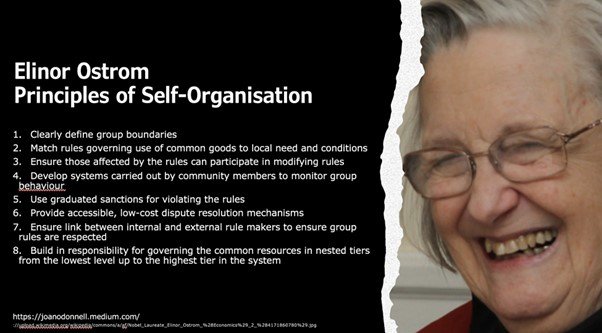
Self-organising systems got a bad name in the social sciences when it was assumed that people will inevitably act out of self-interest to the detriment of the common good. Hardin (1968) wrote about the tragedy of the commons archetype, where people would act in self-interest, thus decreasing everyone’s resources. In other words, we would put short-term gain ahead of long-term sustainability. This view gained far more traction in a neoliberal world and could be said to have become a self-fulfilling prophecy in many of the most publicly observed events of our time. But there are other options. We behave in ways that serve the common good all the time. Elinor Ostrom, political scientist and the first woman to win a Nobel prize in Economics, developed 8 principles for sustainable cooperation which rely on clear boundaries, transparent governance as well as acknowledgment and recognition within the meta-system.
Elinor Ostrom Principles of Self-organisation (Author)
What Self-organising shows us about running organisations
Similarly running organisations as top down hierarchical structures is giving way to other options such as the Viable Systems Model (VSM) and Teal Organisations which chime with the findings about how brain and universe self-organise. Both propose flatter non-hierarchical structures which are not only more adaptive to external conditions (Hoverstadt 2008) but are also more profitable (Laloux 2015) .
Stafford Beer developed VSM in recognition of the fact that organisations needed to be “light on their feet and ready to accommodate themselves to the new situations that would arise faster and faster as time passed” (Beer in Pickering 2004 p499). He used the brain as a model for creating a viable system that relied on both the notion that each part of a viable system both contains and is contained within a viable system. This the concept of recursion — which echos the findings of the current research on the link between the brain and universe. While VSM assumes that someone can intervene and re-engineer the system to work better, others place the people within the system and understand that we are integral parts of the system we seek to change.
Frederic Laloux’s approach to reinventing organisations invites people to bring their whole selves to organisational purpose rather than being straight-jacketed by role. Teal organisations are characterised by self-management, rather than power and control based on title. They emphasise peer relationships where people have high levels of autonomy and are accountable for coordinating with others. Strategy is based on what the world is asking of them and responding accordingly. This makes being part of an organisation or an institution an inevitably ethical enactment of our humanity.
What self-organisation shows us about our systems being
Fritjof Capra suggests that an understanding of how we self-organise can enhance our understanding of ourselves as authentic beings. For Capra, self-organisation occurs where there three conditions are met: diversity, connectivity, and local interaction. In other words, action requires that we engage a system comprising of different elements and authentic action leads to the emergence of something new, rather than an outcome that is preordained by the thinking mind. This is the foundation of our humanity.
“The ideas of self-organization are very important to understand the autonomy, the authenticity and basic humanity of people.” Fritjof Capra
It may seem like a contradiction, but if the brain uses self-organising principles, then it also follows that our bodies cannot just be there just to ferry our brains about on their important business. Our whole being is involved in our organising processes. We do not need to remind ourselves to digest our food or breathe — our organs self-organise. But we also co-regulate our physiological states with each other using not just the brain but the nervous system face and heart (Porges 2017). We are fractal parts of a larger whole: in other words, that we are interconnected beyond our wildest imaginations.
“The essential feature in quantum interconnectedness is that the whole universe is enfolded in everything, and that each thing is enfolded in the whole” David Bohm
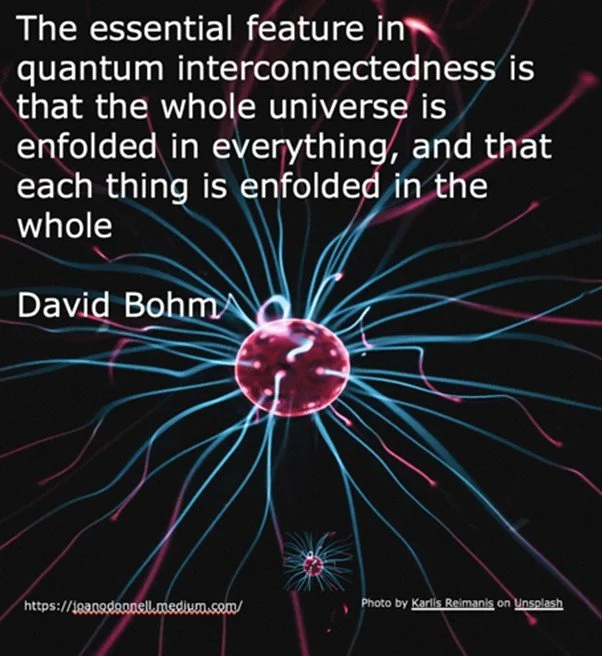
We cannot avoid being connected to other people because we are wired for connection. We cannot sidestep the consequences of our actions, because we are our actions. We cannot separate our private selves from our public selves, because we are responsible for what we contribute to the whole. And we cannot hide behind our words, because we live in language. We are at heart autonomous systems beings. In the words of David Bohm: “the essential feature in quantum interconnectedness is that the whole universe is enfolded in everything, and that each thing is enfolded in the whole.” That includes us Systems Beings.
About the Author: I am a doctoral researcher in psychology and lecturer in systems thinking. I am interested in how we learn to live in our bodies whilst engaging with technology. I am an advanced embodiment practitioner, thinking partner, and facilitator, with an interest in finding our way through messy systemic issues using body wisdom. I live with my husband, son, cats, hens, and bees in Dublin, Ireland. I also edit https://medium.com/living-in-systems.
If this article speaks to you, I would love to get your feedback — remember you can clap up to 50 times for an article! Follow me or https://medium.com/living-in-systems to keep articles like this popping up in your feed.
References:
Hardin, G. (1968). The Tragedy of the Commons. Science, 162(3859), 1243–1248. Retrieved November 30, 2020, from http://www.jstor.org/stable/1724745
Hoverstadt, P. (2008) The Fractal Organisation, Wiley, London.
LaLoux, F (2015) Strategy and Business. https://www.strategy-business.com/author?author=Frederic+Laloux
Ostrom, E. (2012) The Future of the Commons: Beyond Market Failure & Government Regulations Institute of Economic Affairs: Occasional Papers
Porges, S. W. (2017). The pocket guide to the polyvagal theory: The transformative power of feeling safe. WW Norton & Co.
Vazza F., Feletti A. (2020) The Quantitative Comparison Between the Neuronal Network and the Cosmic Web, Frontiers in Physics, Vol. 8 p 491
URL=https://www.frontiersin.org/article/10.3389/fphy.2020.525731
Yates, F, E. (1987) Self-Organizing Systems: The Emergence of Order, Plenum Press. New York and London.
Embodied wisdom as ground-breaking practice
Social Presencing as a way for unsticking ourselves from habitual ways of knowing and being: An Individual Inquiry into embodied wisdom
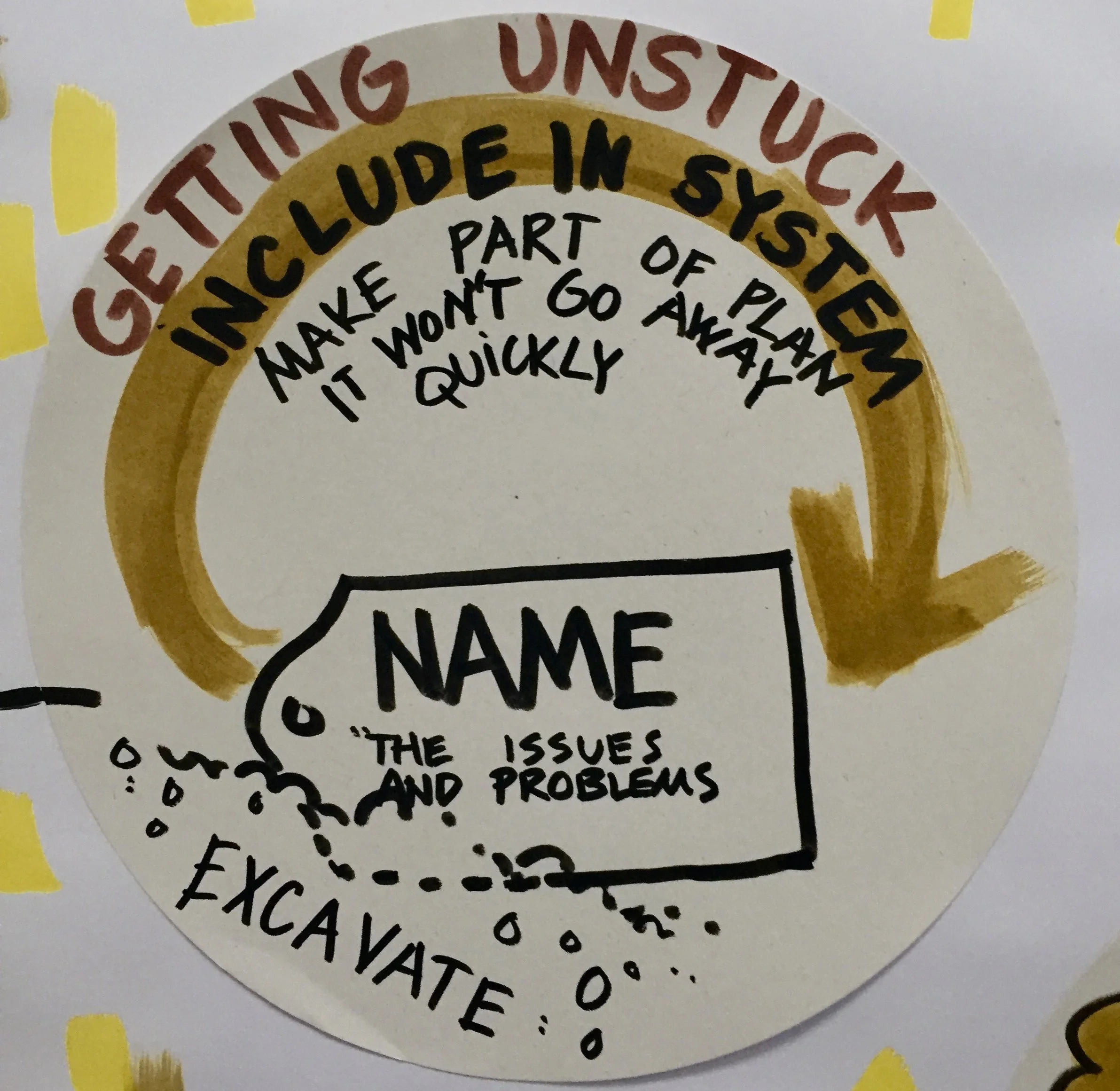
Graphic Harvesting by Esther Blodau https://www.estherblodau.com/
Accessing that spacious place where new ideas and possibilities can arise is something that is available to all of us, once we turn our attention to our body wisdom.
I have experienced how it turns places where I have felt stuck into rich spacious landscapes that allow for more choice than my habitual ways of being.
From tightly pulled knotted string to a loose structure; I am unpicked, reformed, and can breathe more freely again. No longer needing to be right, or feeling all wrong, but released from the energy that holding tight absorbs and with space for curiosity about
What else?
What now?
What next?
Out of this inquiry tumbles a gesture, as I am moved in a moment of time, and a micro-universe reveals itself that is immense and almost ordinary. It is bound in pain and joy.
Sometimes I land in a spot with artful elegance.
Other times I land in a spot that is awkward and unruly.
But almost without effort, I find myself connected to the social body, the ground under my feet, the others on a Zoom call, and the immensity of our interconnectedness is palpable. It is a saner space, that is bigger than trying to fix something, or over manage it.
And I can rest there a while, before the dynamic of being alive propels me forward once more. And within that movement an inner stuckness releases it’s grip.
We have all lived this movement in some way or another.
So how can we practice of moving with greater awareness through that space? How do we develop the capacity to stay with ourselves? And find our way back with the gold and harvest what it might offer? And rest a while, before beginning over again?
More resourced next time, perhaps, with a more grounded trust in the body’s capacity to carry us through?
A methodology has been developed within Social Presencing Theatre (SPT)[1] called a “Stuck” exercise, that builds on three gestures identified by Chilean biologist Varela[2], Depraz [3]and others that arise from their explorations around introspection, phenomenology and contemplative traditions and it forms part of the sensing journey described in Theory U[4].
SPT is an Action Research methodology that encompasses both 1st person, 2nd person and 3rd person inquiry. I am approaching it here from a 1st person inquiry perspective.
There are some fundamental concepts underpinning SPT that support practice. Firstly, it helps to understand that problems never exist in isolation; they are surrounded by other problems that play out across space and time. Stuck places are not personal, they do not indicate that something is wrong with me or you or someone else; instead they can be perceived as restrictions that stop us from moving forward.
We move and are moved regardless of our own sense of stuckness, or felt sense that nothing is changing. Bodies are dynamic — breathing, pulsing, taking information and issuing communications — in constant motion.
Sandra Reeve describes this as the ecological body: we are situated as moving beings who, in a wider context, are dancing with other beings[5]. This understanding takes constant change and not stasis as the homeground of our being.
So movement is our natural default, not being still, stuck, fixed or frozen. Dynamic interaction with others and interdependence is also hardwired into our being.
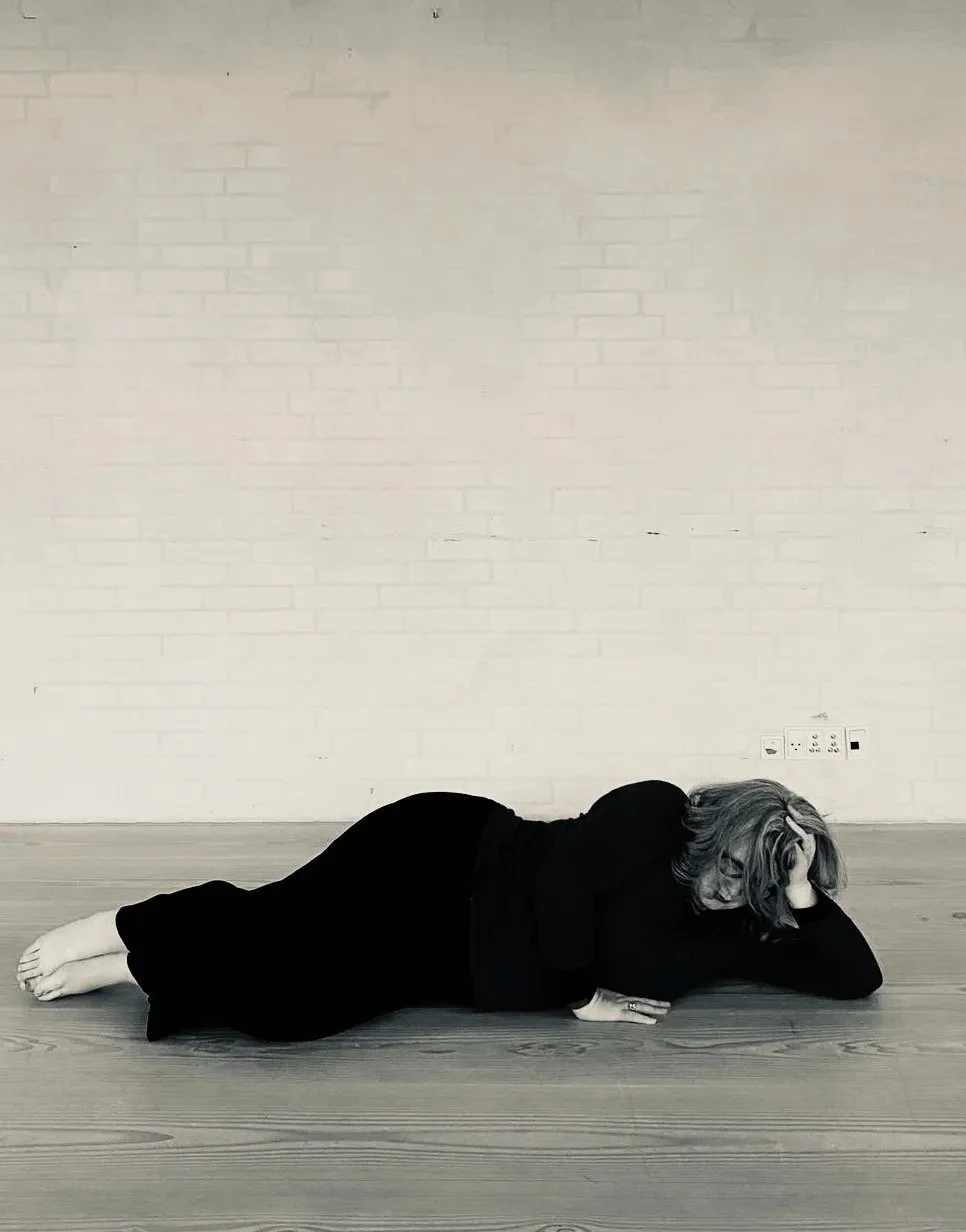
Author in Sculpture 1 “Stuck”

Author in Sculpture 2
This implies that there is no ground on which we can land and say we are unstuck, we are right, we are sorted out. Or that we have solved the problem.
The ground keeps moving and so Social Presencing supports a continual unfolding of “Stuck” rather than arrival at a final destination.
Moving through a stuck place is a sensorial process that cannot happen in abstraction which can be understood as having four distinct phases:
1. Aligning: Use gentle body movements to start with. Follow the body. Slow down and follow the impulse to move and pause, move and pause. Stand, walk, sit, lie down, run, or turn.
Notice what emerges when you give your body parity of esteem with your thinking. Pay attention to what happens when you let go of planning, thinking, acting, miming, dancing, or deliberately representing something in your movements. Become aware of your feet on the earth, your back, your sides, as well as the front of your body.
Aligning head and heart allows greater opportunity for bypassing dualistic Cartesian thinking that creates separation between the mind and body.
It also arrests the tendency to disassociate from situations by getting hooked by notions of objectivity, needing to be right or being perpetually unsure.
Know that the very fact that we are here on the earth at this time gives us enough ground for confidence in our being[6]. There is no agenda. There is no need to fix ourselves, or focus only on what is wrong with us (or other people).
2. Recalling: Call to mind a situation that is problematic and that feels stuck. Lean into the sensations that come with it and get curious about them. Let an inner sense of this situation arise in the body as a shape or a gesture. Do not think about it, just make some movements and follow them for a few moments until they find a natural pause point. Make a shape of a gesture that arises concrete and visible in space.This is known as Sculpture 1.
This can feel counterintuitive, when we are hardwired to move away from pain points and less pleasant emotions. But it is likely that within that stuckness, lies the wisdom, so practice trusting that the body knows a way through.
Pema Chödrön[7] describes this as leaning into “the sharp bits”, as avoidance of our suffering fuels it further.
3. Suspending: Stay alert in this Sculpture 1 gesture and pause. Get curious. Maybe nothing is happening, maybe it is really uncomfortable and the impulse to jump out of it and get busy doing something else is strong. Stay with it and the sense of not knowing what to do next. Suspend judgement and thinking and just be in it. Take an interest in what new information it might contain.
Suspension is the provenance of buddhist traditions that encourage us to be still and notice what arises. It is also the subject of phenomenological inquiry, the study of the mind and body as one being.[8] Husserl who developed phenomenology describes suspension as a gateway into a three dimensional experience of being[9]. Suspension encourages a distancing from theorising or preconceived ideas to focus on the capabilities inherent in our subjective experience of reality, rather than a denial of external reality.
Husserl could describe the experience extremely well but was less able to give expression to the process that would help us practice getting there. Arawana Hayashi who developed SPT describes this place of suspending as the Ma. Ma is a Japanese concept relating to aesthetics: it describes being within a situation with a spaciousness that encompasses different ways of viewing something. It includes time-space and space-time held in an imaginary way. We can find it in the moment when we take pause and sigh: we can find it in the time-space that arises when we clap our hands.
Like Husserl, Hayashi suggests that within these intervals of time, lies the gold from which new possibilities can arise. But first comes that sense of just not knowing what comes next — how to act or how to be and just staying with the pause.
And there is no denying that that can feel awkward, uncomfortable, or discombobulating.
4. Redirecting: Search for the thing that is surprising or different in our body knowing. Notice patterns, notice habits. Observe micro-movements. Look for what is on the edge of perception, what is emerging, what wants to come forth. Focus attention in and hold an awareness of the wider field of energy beyond the body. Follow that impulse and move for a few moments until a second gesture emerges. This is Sculpture 2.
Redirecting is about making the most of the space-time created by suspending to move away from familiar stories, thoughts and ways of being to search about a bit for what information is new.
Redirecting attention involves both leaning into body knowing and out into the social field. It goes beyond thinking and involves the entire being. The social field is described as the “quality of relationships that give rise to patterns of thinking, conversing, and organizing, which in turn produce practical results”[10].
So it is not getting lost in introspection, or losing contact with external reality. Instead it is about picking up on the “emotional tonality” of our being and loosening the grip of our habitual attitude towards the world[11].
5. Letting go: Let go of the need to know, to maintain expertise status by explaining, by grasping onto this new world of Sculpture 2. Allow yourself the confidence in your own embodiment and its innate connectedness to the social body, the earth and sky.
Letting go is about not holding on to that new piece of information too tightly. Instead, it is about carrying it lightly so it can dissolve into the next cyclical round of suspension — so that it doesn’t become a new place where we get stuck.
Letting go stops us from making mausoleums of our emotions, it attends to the temporal nature of our existence and reminds us that we are in constant flux and flow.
Letting go of planning, of fixed ideas and ways of being stuck in the world gives way to new ground of a very different quality. It is far more ephemeral than the safety of being fixated on the things we do or do not have, or invested in other people’s behaviour.
This is the ground of experiencing a personal sense of basic goodness first hand and knowing that there is nothing hang onto, but something shifts. This has been described as a movement from looking for the interior condition to what Depraz (2000) describes as a “passive acceptance, a letting-arrive”.
We can go through this process in a micro-moment, a day, a week, or a lifetime. But resting in the radical awareness that there is nothing to fix and that other options can arise between Sculpture 1 and Sculpture 2 gives rise to a greater tolerance for the discomfort of getting stuck and moving on, spending less time in sumps of our own making, disconnected and isolated.
Getting stuck and moving on. In the ever flowing weave of time and space both within our own body knowing and in connection with the wider social body.
This, enacted, is simply ground-breaking.
https://doi.org/10.6084/m9.figshare.12369164.v1
References:
[1] https://arawanahayashi.com/
[2] https://www.presencing.org/assets/images/aboutus/theory-u/leadership-interview/doc_varela-2000.pdf
[3] Depraz, Nathalie, et al. (2000) On Becoming Aware : A pragmatics of experiencing, John Benjamins Publishing Company, 2000.
[4] https://www.presencing.org/aboutus/theory-u
[5] Reeve, S. (2011) Nine Ways of Seeing a Body, Triarchy Press.
[6] Trungpa, C. (2009) Shambhala: The Sacred Path of the Warrior, Shambhala Publications.
[7] Chodron, P. (2000) When Things Fall Apart: Heart Advice for Difficult Times, Shambhala Press.
[8] Reeve, S. (2011) Nine Ways of Seeing a Body, Triarchy Press.
[9] Zahavi, D. (2003) Husserl’s Phenomenology, Stanford University Press.
[10] Scharmer, O. (2018). The Essentials of Theory U. Core Principles and Applications, Oakland, Berrett-Koehler Publishers, Inc USA.
The Origins of Social Presencing Theatre
A group of advanced Social Presencing Theatre practitioners gathered together in Denmark in January 2020 as part of the Presencing Institute’s research initiative aimed at developing and showcasing SPT, both as a methodology for action research and as a support for the evolution of social systems through the development of tools, methods and protocols.
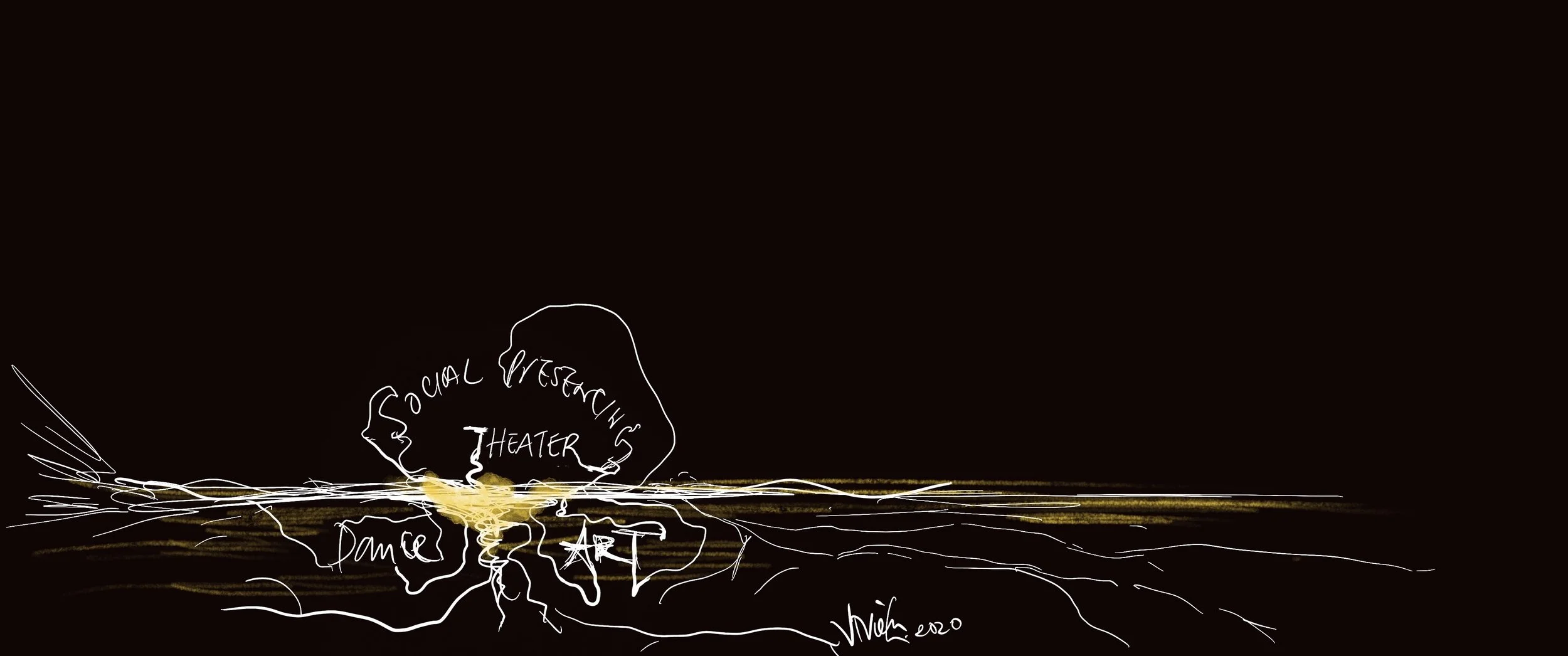
Image of Social Presencing theatre Dance by Vivien Leung www.vivienleung
Social Presencing Theatre is an awareness-based action research methodology for making social fields visible, and a tool for enabling deep systemic change. Its wisdom lies it is simplicity. It strips philosophical insight and deep practice back to 8 engaged practices that access the essence of our being and practice awareness of ourselves, in relation to the whole. Ultimately SPT is an invitation to work with the sanity inherent in our humanity, and the systems we are part of and act from there. It embraces a rich tradition that is not bound by any one discipline or profession. And, importantly, it is accessible to all who wish to access their innate wisdom and act from the collective intelligence available to us all at this time.
Arawana describes SPT as having roots in “mindfulness-awareness, in embodiment, in the performing arts, and in a conviction that the nonverbal experience of “feeling” can be a gateway to accessing wisdom” in a conference paper in 2017 where she also outlines the evolution of the different practices. In addition to these traditions, the influence of philosophy, psychology, and systems thinking, can also be seen as a grounding for understanding the practice.
During one part of our collective inquiry in Denmark, we began the process of excavating the origins surrounding the evolution of the practice. For me, it seemed important to articulate its rich academic heritage for doctoral studies. Ultimately, it was edifying to hear others call out the names those whose inquiring hearts and minds underpin the ground on which the practice and we as practitioners stand. This brief paper briefly sketches out the influences that constellate to bring forth the practice of SPT as mediated through the collaboration between Arawana Hayashi and Otto Scharmer. It is coloured by the inputs of the 16 researchers along with Arawana and even so, it is a watercolour of influences on moving ground, subject to further refinement and evolvement. Embodied knowing is not bound by philosphical knowledge and neat boundaries!
It started with a flipchart pinned to a full length window and a rough system map with different disciplines in bubbles to which we brainstormed names and I scribbled them down as fast as I could. System maps are a way to draw together different elements and show the components and boundary of a system at a point in time, they help structure a system in a simple way that can be communicated to others. This system map gathers together of a range of influences or ingredients if you like that contributed to how SPT has been shaped as a practice. It does so, whilst acknowledging that there is also a rich narrative in the real life complexity involved in weaving theory and practice over time to fine-tune praxis.
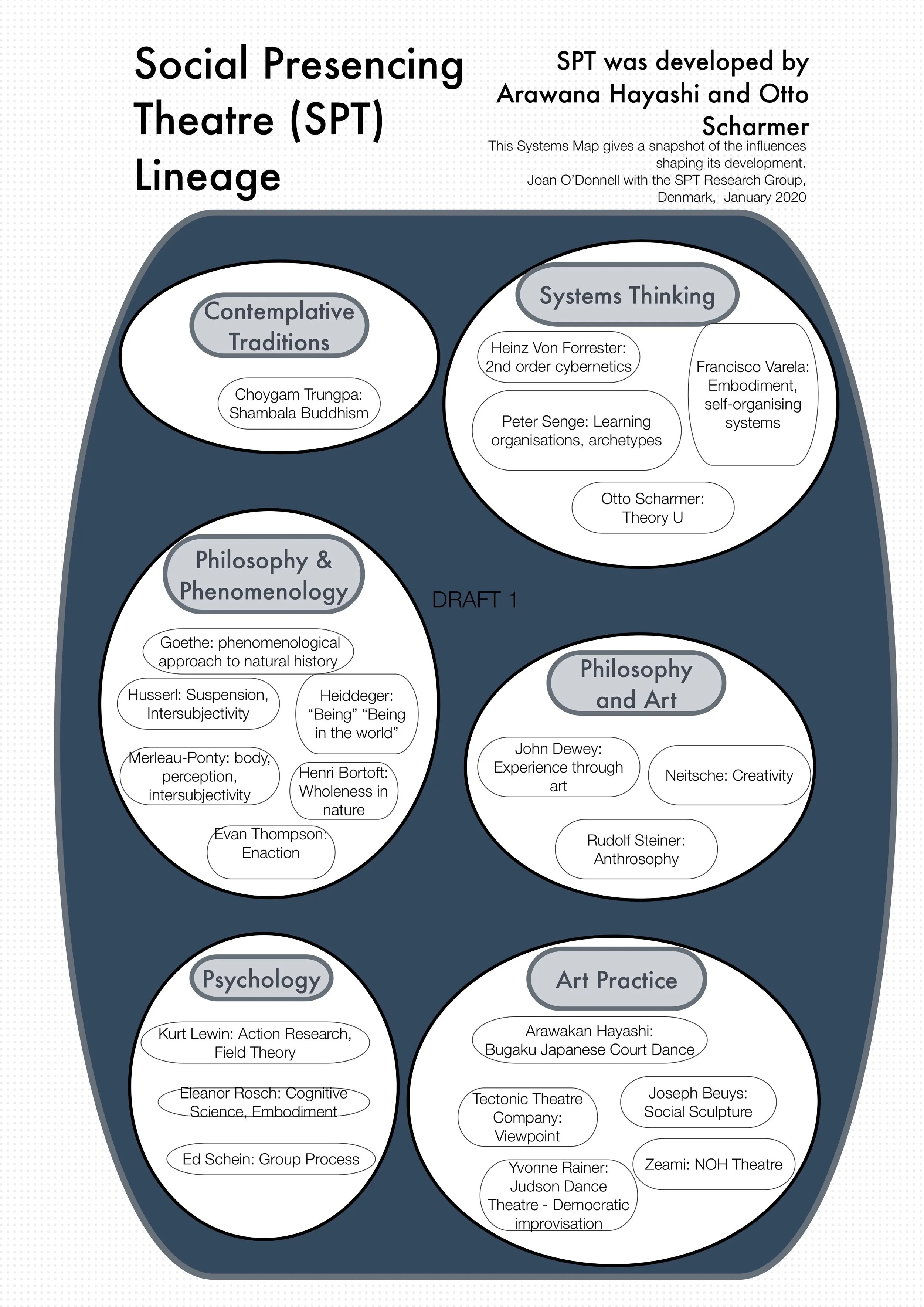
The System Map diagram (Fig 1) distinguishes between those that Arawana Hayashi brought to the mix (coded in orange) and those that have influenced the development of Theory U (coded in blue) and also references thinking that have found expression in both Theory U and SPT (red).
To Reference: O’Donnell, Joan (2020): The Origins of Social Presencing Theatre. figshare. Online resource. https://doi.org/10.6084/m9.figshare.12408818.v1
References:
Hayashi, Arawana (2017) “Social Presencing Theatre, Listening to our body-knowing to access the wisdom that lives in us?” Wisdom Together, “Conscious Leadership” Conference, Oslo, Norway.
With thanks to Vivien Leung for her drawing inspired by our discussion. www.vivienleung.co