
Embodied wisdom as ground-breaking practice
Social Presencing as a way for unsticking ourselves from habitual ways of knowing and being: An Individual Inquiry into embodied wisdom
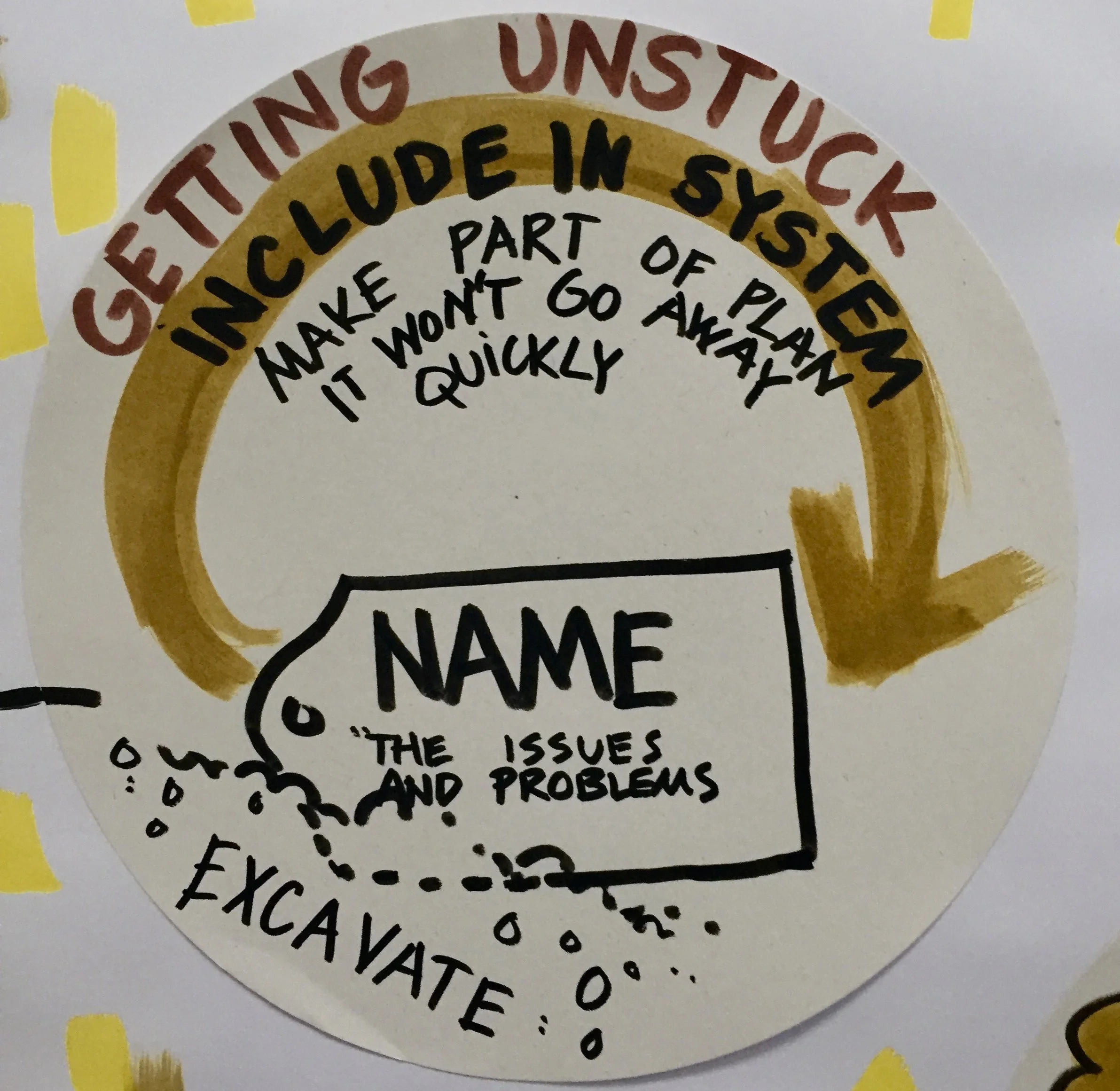
Graphic Harvesting by Esther Blodau https://www.estherblodau.com/
Accessing that spacious place where new ideas and possibilities can arise is something that is available to all of us, once we turn our attention to our body wisdom.
I have experienced how it turns places where I have felt stuck into rich spacious landscapes that allow for more choice than my habitual ways of being.
From tightly pulled knotted string to a loose structure; I am unpicked, reformed, and can breathe more freely again. No longer needing to be right, or feeling all wrong, but released from the energy that holding tight absorbs and with space for curiosity about
What else?
What now?
What next?
Out of this inquiry tumbles a gesture, as I am moved in a moment of time, and a micro-universe reveals itself that is immense and almost ordinary. It is bound in pain and joy.
Sometimes I land in a spot with artful elegance.
Other times I land in a spot that is awkward and unruly.
But almost without effort, I find myself connected to the social body, the ground under my feet, the others on a Zoom call, and the immensity of our interconnectedness is palpable. It is a saner space, that is bigger than trying to fix something, or over manage it.
And I can rest there a while, before the dynamic of being alive propels me forward once more. And within that movement an inner stuckness releases it’s grip.
We have all lived this movement in some way or another.
So how can we practice of moving with greater awareness through that space? How do we develop the capacity to stay with ourselves? And find our way back with the gold and harvest what it might offer? And rest a while, before beginning over again?
More resourced next time, perhaps, with a more grounded trust in the body’s capacity to carry us through?
A methodology has been developed within Social Presencing Theatre (SPT)[1] called a “Stuck” exercise, that builds on three gestures identified by Chilean biologist Varela[2], Depraz [3]and others that arise from their explorations around introspection, phenomenology and contemplative traditions and it forms part of the sensing journey described in Theory U[4].
SPT is an Action Research methodology that encompasses both 1st person, 2nd person and 3rd person inquiry. I am approaching it here from a 1st person inquiry perspective.
There are some fundamental concepts underpinning SPT that support practice. Firstly, it helps to understand that problems never exist in isolation; they are surrounded by other problems that play out across space and time. Stuck places are not personal, they do not indicate that something is wrong with me or you or someone else; instead they can be perceived as restrictions that stop us from moving forward.
We move and are moved regardless of our own sense of stuckness, or felt sense that nothing is changing. Bodies are dynamic — breathing, pulsing, taking information and issuing communications — in constant motion.
Sandra Reeve describes this as the ecological body: we are situated as moving beings who, in a wider context, are dancing with other beings[5]. This understanding takes constant change and not stasis as the homeground of our being.
So movement is our natural default, not being still, stuck, fixed or frozen. Dynamic interaction with others and interdependence is also hardwired into our being.
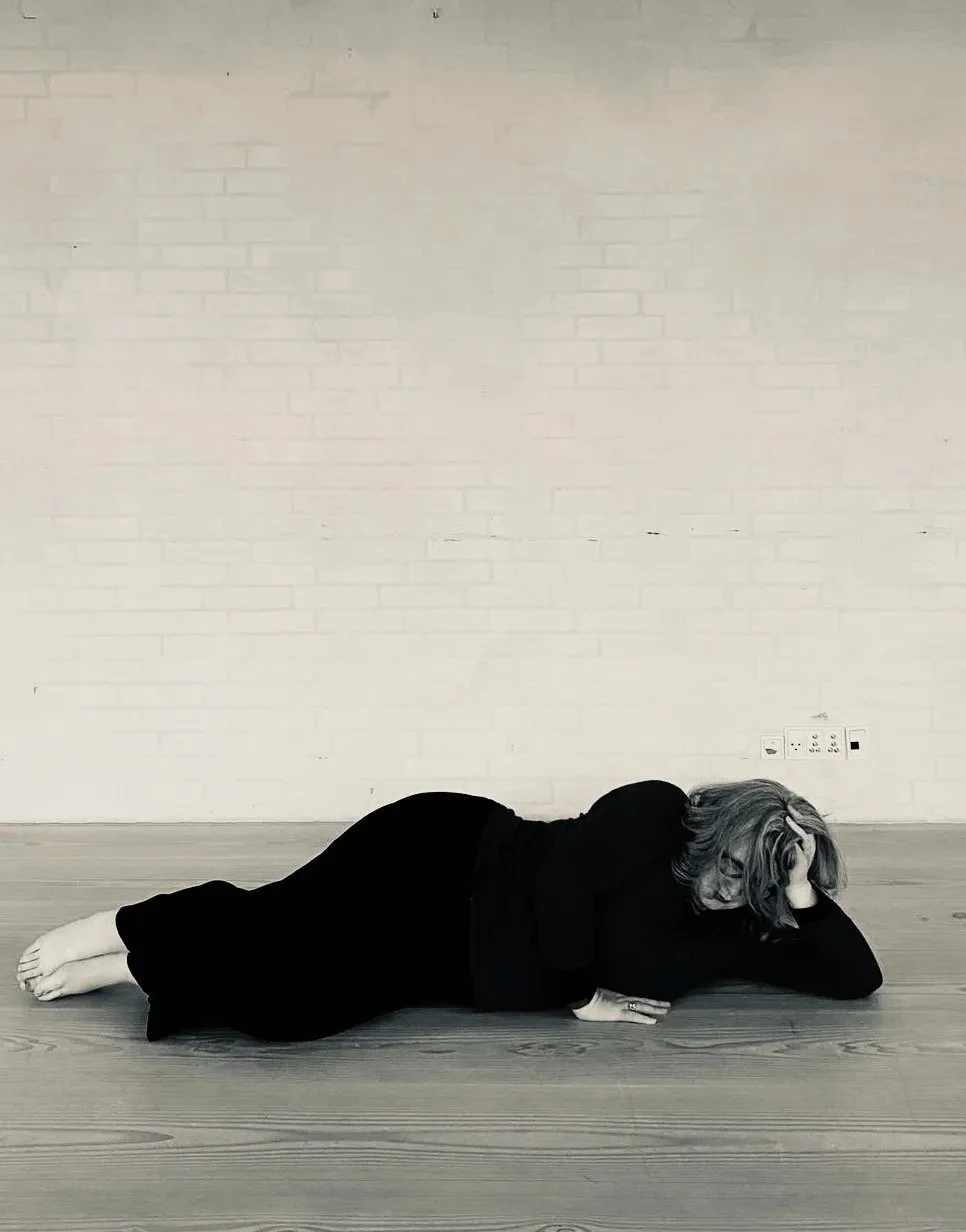
Author in Sculpture 1 “Stuck”

Author in Sculpture 2
This implies that there is no ground on which we can land and say we are unstuck, we are right, we are sorted out. Or that we have solved the problem.
The ground keeps moving and so Social Presencing supports a continual unfolding of “Stuck” rather than arrival at a final destination.
Moving through a stuck place is a sensorial process that cannot happen in abstraction which can be understood as having four distinct phases:
1. Aligning: Use gentle body movements to start with. Follow the body. Slow down and follow the impulse to move and pause, move and pause. Stand, walk, sit, lie down, run, or turn.
Notice what emerges when you give your body parity of esteem with your thinking. Pay attention to what happens when you let go of planning, thinking, acting, miming, dancing, or deliberately representing something in your movements. Become aware of your feet on the earth, your back, your sides, as well as the front of your body.
Aligning head and heart allows greater opportunity for bypassing dualistic Cartesian thinking that creates separation between the mind and body.
It also arrests the tendency to disassociate from situations by getting hooked by notions of objectivity, needing to be right or being perpetually unsure.
Know that the very fact that we are here on the earth at this time gives us enough ground for confidence in our being[6]. There is no agenda. There is no need to fix ourselves, or focus only on what is wrong with us (or other people).
2. Recalling: Call to mind a situation that is problematic and that feels stuck. Lean into the sensations that come with it and get curious about them. Let an inner sense of this situation arise in the body as a shape or a gesture. Do not think about it, just make some movements and follow them for a few moments until they find a natural pause point. Make a shape of a gesture that arises concrete and visible in space.This is known as Sculpture 1.
This can feel counterintuitive, when we are hardwired to move away from pain points and less pleasant emotions. But it is likely that within that stuckness, lies the wisdom, so practice trusting that the body knows a way through.
Pema Chödrön[7] describes this as leaning into “the sharp bits”, as avoidance of our suffering fuels it further.
3. Suspending: Stay alert in this Sculpture 1 gesture and pause. Get curious. Maybe nothing is happening, maybe it is really uncomfortable and the impulse to jump out of it and get busy doing something else is strong. Stay with it and the sense of not knowing what to do next. Suspend judgement and thinking and just be in it. Take an interest in what new information it might contain.
Suspension is the provenance of buddhist traditions that encourage us to be still and notice what arises. It is also the subject of phenomenological inquiry, the study of the mind and body as one being.[8] Husserl who developed phenomenology describes suspension as a gateway into a three dimensional experience of being[9]. Suspension encourages a distancing from theorising or preconceived ideas to focus on the capabilities inherent in our subjective experience of reality, rather than a denial of external reality.
Husserl could describe the experience extremely well but was less able to give expression to the process that would help us practice getting there. Arawana Hayashi who developed SPT describes this place of suspending as the Ma. Ma is a Japanese concept relating to aesthetics: it describes being within a situation with a spaciousness that encompasses different ways of viewing something. It includes time-space and space-time held in an imaginary way. We can find it in the moment when we take pause and sigh: we can find it in the time-space that arises when we clap our hands.
Like Husserl, Hayashi suggests that within these intervals of time, lies the gold from which new possibilities can arise. But first comes that sense of just not knowing what comes next — how to act or how to be and just staying with the pause.
And there is no denying that that can feel awkward, uncomfortable, or discombobulating.
4. Redirecting: Search for the thing that is surprising or different in our body knowing. Notice patterns, notice habits. Observe micro-movements. Look for what is on the edge of perception, what is emerging, what wants to come forth. Focus attention in and hold an awareness of the wider field of energy beyond the body. Follow that impulse and move for a few moments until a second gesture emerges. This is Sculpture 2.
Redirecting is about making the most of the space-time created by suspending to move away from familiar stories, thoughts and ways of being to search about a bit for what information is new.
Redirecting attention involves both leaning into body knowing and out into the social field. It goes beyond thinking and involves the entire being. The social field is described as the “quality of relationships that give rise to patterns of thinking, conversing, and organizing, which in turn produce practical results”[10].
So it is not getting lost in introspection, or losing contact with external reality. Instead it is about picking up on the “emotional tonality” of our being and loosening the grip of our habitual attitude towards the world[11].
5. Letting go: Let go of the need to know, to maintain expertise status by explaining, by grasping onto this new world of Sculpture 2. Allow yourself the confidence in your own embodiment and its innate connectedness to the social body, the earth and sky.
Letting go is about not holding on to that new piece of information too tightly. Instead, it is about carrying it lightly so it can dissolve into the next cyclical round of suspension — so that it doesn’t become a new place where we get stuck.
Letting go stops us from making mausoleums of our emotions, it attends to the temporal nature of our existence and reminds us that we are in constant flux and flow.
Letting go of planning, of fixed ideas and ways of being stuck in the world gives way to new ground of a very different quality. It is far more ephemeral than the safety of being fixated on the things we do or do not have, or invested in other people’s behaviour.
This is the ground of experiencing a personal sense of basic goodness first hand and knowing that there is nothing hang onto, but something shifts. This has been described as a movement from looking for the interior condition to what Depraz (2000) describes as a “passive acceptance, a letting-arrive”.
We can go through this process in a micro-moment, a day, a week, or a lifetime. But resting in the radical awareness that there is nothing to fix and that other options can arise between Sculpture 1 and Sculpture 2 gives rise to a greater tolerance for the discomfort of getting stuck and moving on, spending less time in sumps of our own making, disconnected and isolated.
Getting stuck and moving on. In the ever flowing weave of time and space both within our own body knowing and in connection with the wider social body.
This, enacted, is simply ground-breaking.
https://doi.org/10.6084/m9.figshare.12369164.v1
References:
[1] https://arawanahayashi.com/
[2] https://www.presencing.org/assets/images/aboutus/theory-u/leadership-interview/doc_varela-2000.pdf
[3] Depraz, Nathalie, et al. (2000) On Becoming Aware : A pragmatics of experiencing, John Benjamins Publishing Company, 2000.
[4] https://www.presencing.org/aboutus/theory-u
[5] Reeve, S. (2011) Nine Ways of Seeing a Body, Triarchy Press.
[6] Trungpa, C. (2009) Shambhala: The Sacred Path of the Warrior, Shambhala Publications.
[7] Chodron, P. (2000) When Things Fall Apart: Heart Advice for Difficult Times, Shambhala Press.
[8] Reeve, S. (2011) Nine Ways of Seeing a Body, Triarchy Press.
[9] Zahavi, D. (2003) Husserl’s Phenomenology, Stanford University Press.
[10] Scharmer, O. (2018). The Essentials of Theory U. Core Principles and Applications, Oakland, Berrett-Koehler Publishers, Inc USA.
The Origins of Social Presencing Theatre
A group of advanced Social Presencing Theatre practitioners gathered together in Denmark in January 2020 as part of the Presencing Institute’s research initiative aimed at developing and showcasing SPT, both as a methodology for action research and as a support for the evolution of social systems through the development of tools, methods and protocols.
Image of Social Presencing theatre Dance by Vivien Leung www.vivienleung
Social Presencing Theatre is an awareness-based action research methodology for making social fields visible, and a tool for enabling deep systemic change. Its wisdom lies it is simplicity. It strips philosophical insight and deep practice back to 8 engaged practices that access the essence of our being and practice awareness of ourselves, in relation to the whole. Ultimately SPT is an invitation to work with the sanity inherent in our humanity, and the systems we are part of and act from there. It embraces a rich tradition that is not bound by any one discipline or profession. And, importantly, it is accessible to all who wish to access their innate wisdom and act from the collective intelligence available to us all at this time.
Arawana describes SPT as having roots in “mindfulness-awareness, in embodiment, in the performing arts, and in a conviction that the nonverbal experience of “feeling” can be a gateway to accessing wisdom” in a conference paper in 2017 where she also outlines the evolution of the different practices. In addition to these traditions, the influence of philosophy, psychology, and systems thinking, can also be seen as a grounding for understanding the practice.
During one part of our collective inquiry in Denmark, we began the process of excavating the origins surrounding the evolution of the practice. For me, it seemed important to articulate its rich academic heritage for doctoral studies. Ultimately, it was edifying to hear others call out the names those whose inquiring hearts and minds underpin the ground on which the practice and we as practitioners stand. This brief paper briefly sketches out the influences that constellate to bring forth the practice of SPT as mediated through the collaboration between Arawana Hayashi and Otto Scharmer. It is coloured by the inputs of the 16 researchers along with Arawana and even so, it is a watercolour of influences on moving ground, subject to further refinement and evolvement. Embodied knowing is not bound by philosphical knowledge and neat boundaries!
It started with a flipchart pinned to a full length window and a rough system map with different disciplines in bubbles to which we brainstormed names and I scribbled them down as fast as I could. System maps are a way to draw together different elements and show the components and boundary of a system at a point in time, they help structure a system in a simple way that can be communicated to others. This system map gathers together of a range of influences or ingredients if you like that contributed to how SPT has been shaped as a practice. It does so, whilst acknowledging that there is also a rich narrative in the real life complexity involved in weaving theory and practice over time to fine-tune praxis.
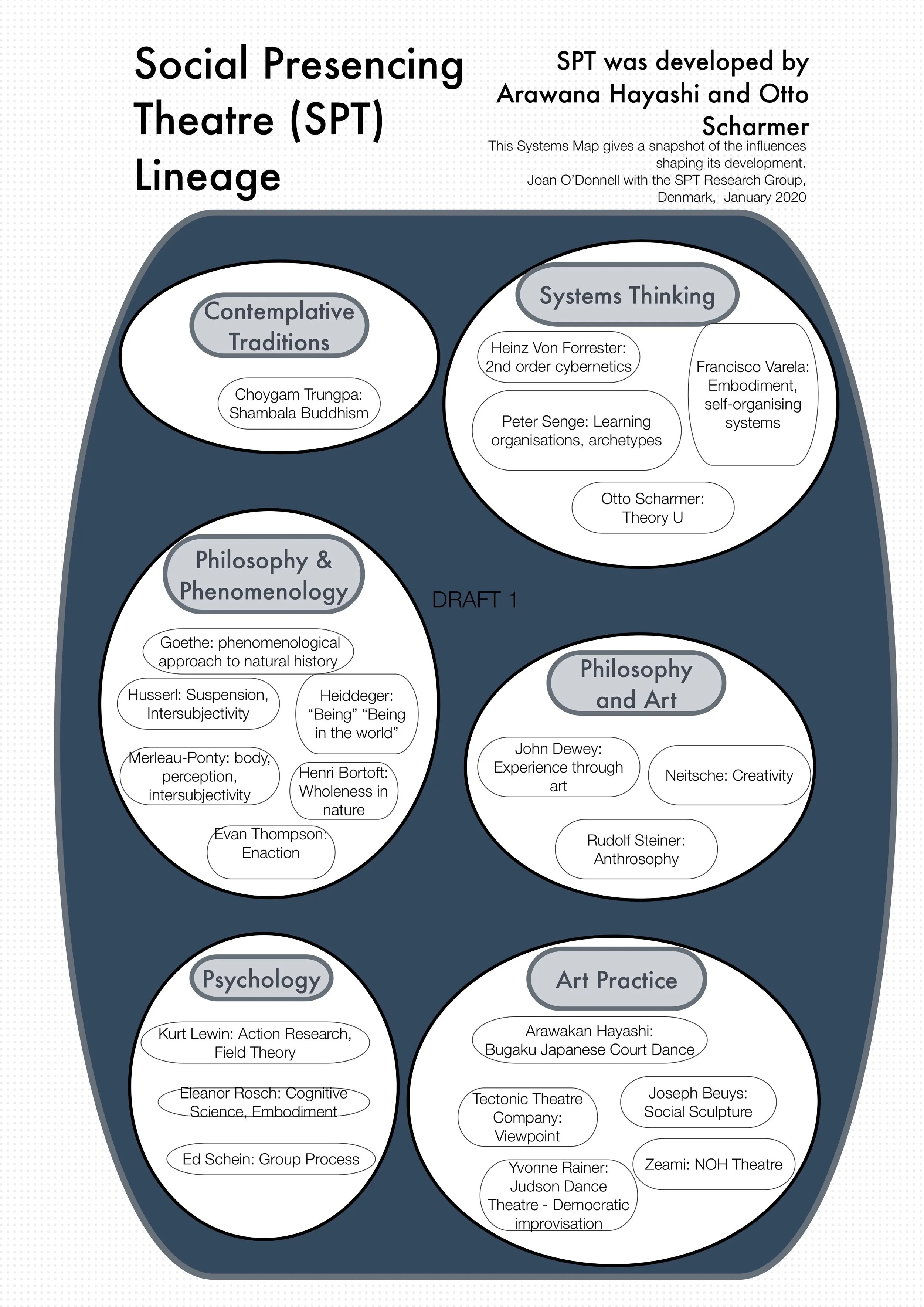
The System Map diagram (Fig 1) distinguishes between those that Arawana Hayashi brought to the mix (coded in orange) and those that have influenced the development of Theory U (coded in blue) and also references thinking that have found expression in both Theory U and SPT (red).
To Reference: O’Donnell, Joan (2020): The Origins of Social Presencing Theatre. figshare. Online resource. https://doi.org/10.6084/m9.figshare.12408818.v1
References:
Hayashi, Arawana (2017) “Social Presencing Theatre, Listening to our body-knowing to access the wisdom that lives in us?” Wisdom Together, “Conscious Leadership” Conference, Oslo, Norway.
With thanks to Vivien Leung for her drawing inspired by our discussion. www.vivienleung.co